

You’re no stranger to the constant battle against dampness if you dwell in a humid region. The science behind basement waterproofing goes beyond merely applying a sealant; it’s about understanding the intricate dance between hydrostatic pressure and capillary action. From using silicate-based sealers to performing routine maintenance, there’s a lot that goes into protecting your basement from moisture-related issues. But how exactly do these methods work, and why are they so vital in humid climates? Let’s explore this fascinating subject and help you keep your basement dry and secure.
Understanding Humidity and Basements
Humidity, the invisible enemy of your basement, can wreak havoc if left unchecked. This pervasive moisture, which often goes unnoticed, can create an environment conducive to mold growth and structural damage.
It’s crucial to understand how humidity works to effectively protect your basement from its harmful effects.
Humidity refers to the amount of water vapor present in the air. It’s measured by a percentage—the higher the percentage, the more water vapor the air holds.
Basements, being underground, naturally have higher humidity levels due to cooler temperatures and limited ventilation.
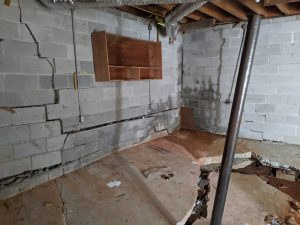
These conditions enable condensation, an integral part of the humidity problem. When warm, humid air contacts a cooler surface like your basement walls or floor, it can’t hold as much moisture.
This excess moisture then condenses into water droplets. It’s this process that can cause dampness and moisture-related issues in your basement.
Common Basement Moisture Problems
Now that you have a grasp on how humidity impacts your basement, let’s examine the common moisture problems you might face.
First, condensation is an issue that arises when warm, humid air comes into contact with cooler basement walls and floors. This causes the moisture in the air to condensate, leading to damp patches and potential mold growth.
Next, you might encounter seepage problems. This usually occurs when there’s a high water table or after heavy rainfall, and water seeps through cracks in your basement walls or floors. It can result in significant water damage over time if not addressed promptly.
Lastly, let’s discuss leaks. Leaks can occur due to faulty pipes or if your basement isn’t properly sealed. While small leaks mightn’t seem concerning, they can escalate quickly, causing substantial damage.
In a humid region, these moisture problems are more prevalent and can severely impact your basement’s structural integrity. Understanding these issues is the first step to preventing them.
In the next section, we’ll explore the science behind waterproofing, providing you with the knowledge to combat these problems effectively.
The Science Behind Waterproofing
Ever wondered how waterproofing works? Let’s explore.
Fundamentally, waterproofing involves creating a barrier to prevent water from penetrating a specific area. In humid regions, it’s vital to understand that the primary goal isn’t just to keep water out, but also to manage the moisture that inevitably gets in.
Waterproofing works by applying principles of hydrostatic pressure, which is the pressure exerted by a fluid due to gravity. When you waterproof a basement, you’re fundamentally creating a pressure-resistant barrier. This barrier must be strong enough to resist the pressure of water in the soil surrounding the basement.
Further, capillary action plays a part too. This is the ability of a liquid to flow against gravity where liquid spontaneously rises in a narrow space such as between the walls of a basement. Waterproofing materials should be able to disrupt this capillary action.
Finally, the principle of evaporation is important too. In a humid region, there’s always going to be some moisture. Good waterproofing slows the rate of evaporation, reducing the overall moisture level in your basement.
Waterproofing Materials and Their Properties
Understanding the science behind waterproofing is only half the battle; applying that knowledge through the right materials is the other. You’ll find various waterproofing materials in the market. However, their effectiveness largely depends on their properties and the region’s humidity levels.
First, let’s talk about silicate-based concrete sealers. They react chemically with the concrete to form a hard, water-repellent surface. They’re great for blocking surface moisture, but they’re not recommended for regions with high groundwater levels as they can’t withstand hydrostatic pressure.
Next up are waterproofing paints. They’re easy to apply and can seal minor cracks, but they’re not durable in highly humid regions. The paint peels off over time due to the constant exposure to moisture.
Lastly, there are plastic sheets and panels. They’re effective against water leakage, but they don’t provide a solution for water vapor. In high humidity regions, condensation can occur under these sheets, leading to mold growth.
Effective Waterproofing Techniques
In nearly every humid region, you can employ a variety of effective waterproofing techniques to protect your basement from moisture damage. One such technique is interior sealants which, when applied, create a watertight barrier to block condensation and minor seepage. However, they’re not a permanent solution to water intrusion.
Exterior waterproofing, on the other hand, is a more robust approach. It involves the application of a waterproof coating or membrane to the exterior wall of the basement, which prevents water from making its way into the structure.
Combining this with a drainage system, designed to direct water away from your home’s foundation, can greatly improve the efficacy of the waterproofing.
Another method is installing a sump pump system. This is particularly effective in areas where flooding is common. The system collects water entering your basement and pumps it away from the house.
Lastly, don’t overlook the importance of proper gutter and downspout maintenance. By ensuring they’re clear of debris and directing water away from your home, you’ll minimize the risk of water pooling around your foundation, a major cause of basement leaks.
Costs Associated With Basement Waterproofing
While the techniques discussed above can safeguard your basement against water damage, it’s equally important to factor in the costs associated with each approach.
You’ll find that expenses can vary greatly depending on the chosen method, complexity of the job, and the size of your basement.
Interior waterproofing, which includes sealants and coatings, can range from $500 to $3,000 for DIY methods. Hiring a professional can push that cost up to $5,000 or more, depending on the severity of the problem.
Exterior waterproofing is typically more expensive due to the excavation required, but it offers a more robust solution. A full exterior waterproofing system can cost between $10,000 and $25,000.
Drainage systems, another key component, require a significant investment. Installing a sump pump can cost between $600 and $1,000, while French drains vary from $5,000 to $6,000.
Lastly, remember to factor in the cost of materials, labor, and any potential repairs to damaged areas.
The total cost can be substantial, but it’s a worthy investment to protect your home from the damaging effects of moisture, especially in humid climates.
Maintaining a Waterproofed Basement
Once your basement’s waterproofed, you’ll need to guarantee its longevity.
This involves choosing durable, high-quality waterproofing materials, establishing regular maintenance practices, and being vigilant about detecting signs of leakage.
Each of these aspects plays a crucial role in maintaining the integrity of your waterproofed basement, and we’ll analyze them thoroughly in the following sections.
Waterproofing Material Selection
Choosing the right waterproofing materials is essential for maintaining a dry basement, especially in humid regions.
You’ll need to take into account factors like the nature of the water problem, the type of foundation, and the region’s climate.
Firstly, evaluate the water issue. If it’s a minor dampness problem, a good quality water repellent paint might be enough.
However, for more severe issues such as water seepage or flooding, you’ll need stronger materials like a waterproofing membrane or a drainage system.
The type of foundation also matters. Concrete foundations usually require different waterproofing materials compared to brick or stone foundations.
For concrete, a crystalline waterproofing material is often used as it penetrates deep into the concrete, making it waterproof.
Meanwhile, brick or stone foundations usually benefit from cementitious waterproofing or bituminous coatings.
Lastly, assess the local climate. In humid regions, you’ll need materials that can resist high moisture levels and drastic temperature changes.
Silicone-based waterproofing materials are often recommended as they resist moisture and remain flexible in varying temperatures.
Regular Maintenance Practices
Proper maintenance is your basement’s best defense against the unforgiving humidity. It’s vital to remember that even the most reliable waterproofing system can fail without regular upkeep.
Don’t allow your efforts in waterproofing to go to waste; adopt a diligent maintenance routine.
Start by inspecting your sump pump regularly. It’s an indispensable part of your waterproofing system, and it’s your first line of defense when groundwater levels rise. Make certain it’s working efficiently. Test it by pouring a bucket of water into the sump pit; it should automatically turn on and pump the water out.
Gutter cleaning is another essential task. Verify your gutters and downspouts are clear of debris and effectively channeling water away from your foundation. Water pooling near your home’s base can compromise its stability and jeopardize your waterproofing system.
Lastly, monitor the humidity levels in your basement. Invest in a hygrometer to keep track. If the humidity consistently exceeds 60%, consider running a dehumidifier to control moisture levels.
Detecting Leakage Signs
Understanding the signs of leakage in your basement is essential in maintaining its waterproof integrity. Start by inspecting for visible water trails or damp spots on walls, ceilings, and floors. These are typically the first indicators of a leak. Pay special attention to areas near pipes, window wells, and joints where the wall meets the floor.
Next, assess the humidity level. High basement humidity, often resulting in a musty smell, can be a leakage sign. Purchase a hygrometer to monitor your basement’s relative humidity. If it’s consistently above 60%, you might’ve a leak.
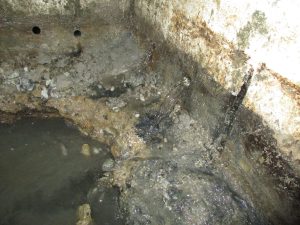
Beware of mold and mildew. They thrive in damp environments and can cause health issues. If you spot any, it’s a red flag that water’s seeping in.
Look out for efflorescence. It’s a white, chalky substance that forms on concrete or brick surfaces when water evaporates, leaving behind salt deposits. Its presence suggests water intrusion.
Lastly, don’t dismiss wall cracks. While some cracks are harmless, others can signify serious issues. Keep an eye on them. If they widen or leak, it’s time to call a professional.
Case Study: Successful Basement Waterproofing
Let’s plunge into a real-life example illustrating successful basement waterproofing. Picture a 1970s suburban home in the humid climate of Florida, plagued by persistent basement leaks. The homeowner, tired of persistent dampness and the looming threat of mold, engaged a waterproofing expert.
An extensive inspection uncovered several issues. Cracks in the foundation were allowing water seepage, and poor soil drainage was exacerbating the problem. The sump pump was also malfunctioning due to wear and tear.
The waterproofing team took a multi-pronged approach. They started by sealing the foundation cracks using a high-grade epoxy resin, which can withstand hydrostatic pressure.
Next, they improved the soil grading around the home to promote efficient water runoff. They replaced the old sump pump with a more robust model, equipped with a battery backup system to guarantee functionality even during power outages.
After implementation, the basement remained dry, even during heavy rainfall. This success story highlights the effectiveness of extensive, analytical problem-solving in basement waterproofing.
It emphasizes the need for professional expertise, a thorough understanding of the problem, and the application of appropriate, high-quality solutions.
You’ve learned how humidity impacts your basement and the science behind effective waterproofing. Using materials like silicate-based sealers and crystalline waterproofing, you can create a barrier against moisture. Remember, proper maintenance is key—you’ve got to regularly inspect and test your drainage systems. Waterproofing isn’t cheap, but it’s a worthy investment. By understanding and applying this science, you’re safeguarding your property’s structural integrity and ensuring a moisture-free basement.

20 + years of experience! – It’s hard to find another company like ours. Our team of experts have decades of experience in residential and commercial construction, plumbing, masonry, and carpentry skills. Not just waterproofing …
5 Star Customer Satisfaction Guarantees! – We receive many compliments on our level of professionalism, cutting edge materials, hard working crews, cleanliness, and customer service: which is something hard to find in our industry. Our goal is to exceed your expectations from start to finish! We are here to alleviate your anxiety and will work our hardest to make sure that all of your concerns are achieved 100%.
