

You’ve likely never given much thought to your crawl space, but did you know it could be silently impacting the health of your home? Consider this: excess moisture in your crawl space can lead to mold growth, structural damage, and even negatively affect your home’s energy efficiency. Two potential solutions are vapor barriers and dehumidifiers. But how do they work, and which one’s right for you? Let’s explore the options to guarantee your home’s longevity and your indoor comfort. The answer may surprise you.
Key Takeaways
- Vapor barriers serve as a primary defense against moisture in crawl spaces, reducing mold risks and improving energy efficiency.
- Dehumidifiers function by drawing in air, condensing moisture, and expelling drier air, preventing mildew and structural damage.
- The selection of a dehumidifier depends on its capacity, size, features, and the size and humidity level of the crawl space.
- Dehumidifiers, while initially costly, offer long-term benefits such as improved air quality, structural protection, and enhanced HVAC efficiency.
- Considering factors like climate, budget, crawl space size, and current condition will help determine if a vapor barrier or dehumidifier is needed.
Understanding Your Crawl Space
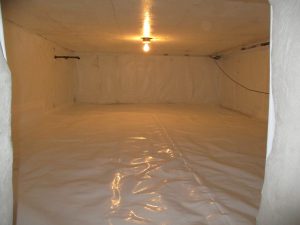
Your crawl space, often considered the home’s unseen workhorse, plays an important role in maintaining the structural integrity of your house.
It’s this small, often ignored area beneath your home that provides a buffer between your living space and the damp, cold earth below. You mightn’t realize it, but your crawl space can greatly influence the air quality inside your home.
The primary function of a crawl space is to act as a protective barrier against ground moisture. By lifting your home off the ground, it prevents direct contact with the soil, which can be a source of dampness and potential problems.
However, if not correctly maintained and waterproofed, this area can become a breeding ground for mold, mildew, and pests.
Your crawl space also acts as a conduit for plumbing, electrical, and HVAC systems, making it an important part of your home’s overall functionality.
As a result, keeping this area dry, clean, and well-maintained is vital to ensuring the health and longevity of these systems.
Understanding the importance of your crawl space and ensuring its proper maintenance is the first step towards effective crawl space waterproofing.
In the next section, we’ll discuss the dangers of excess moisture and its impact.
The Dangers of Excess Moisture
When not properly maintained, your crawl space can become a hub for excess moisture. This isn’t merely an inconvenience. It’s a serious issue that can lead to a host of problems.
Firstly, excess moisture encourages the growth of mold and mildew. They’re not just unsightly and smelly; they pose significant health risks. Prolonged exposure can lead to respiratory problems, allergies, and other health issues. If you’ve been coughing, sneezing, or experiencing other unusual symptoms, it could be due to mold in your crawl space.
Secondly, excess moisture can damage the structural integrity of your home. Over time, it can cause wood to rot and metal to rust, weakening the foundation of your home. It’s not a sudden disaster, but a slow, insidious process. You mightn’t notice the damage until it’s too late and costly repairs are needed.
Lastly, moisture attracts pests like termites and rodents. Your crawl space could become a cozy home for unwanted guests that pose another set of risks to your home’s integrity and your health.
The Importance of Crawl Space Waterproofing
Ignoring the dampness creeping into your crawl space is like turning a blind eye to a ticking time bomb.
It’s not just about the unpleasant musky smell or the occasional bug issue. The stakes are far higher than you might imagine.
An improperly waterproofed crawl space can lead to a host of problems that go beyond just cosmetic damage.
Here’s why it’s essential to waterproof your crawl space:
- Structural Damage: Moisture can cause your wooden beams to rot, compromising the integrity of your house’s foundation.
- Health Risks: Damp conditions breed mold and mildew, leading to poor air quality and potential health hazards.
- Energy Inefficiency: Moist air requires more energy to heat and cool, leading to higher utility bills.
- Decreased Property Value: A damp crawl space is a big red flag for potential buyers, negatively impacting the value of your property.
Waterproofing your crawl space is an investment in your home’s future.
It’s not just about preventing issues—it’s about creating a healthier, safer, and more energy-efficient living space.
An Introduction to Vapor Barriers
Often, the first line of defense against moisture in your crawl space is a vapor barrier. It’s a simple, yet effective tool that can protect your home from the damaging effects of excess moisture. Think of it as a shield that blocks water vapor from seeping into your crawl space.
So, what’s a vapor barrier? It’s a sheet of material, usually plastic or foil sheet, designed to resist the diffusion of moisture through your crawl space wall, floor, or ceiling. You might think of it as a waterproof blanket for your crawl space.
Regardless of where you live, whether it’s a humid area or a dry one, a vapor barrier is essential. It’s not just about keeping your crawl space dry; it’s about protecting your home.
Without a vapor barrier, you’re inviting trouble, and that trouble comes in the form of mold, mildew, wood rot, and even structural damage.
How Vapor Barriers Work
You might be wondering how vapor barriers actually work in waterproofing your crawl space.
Let’s simplify it: they block moisture from seeping into your home, protecting its structure and your indoor air quality.
We’ll look at how you can effectively implement these barriers to keep your home dry and healthy.
Understanding Vapor Barrier Functionality
To fully appreciate the importance of crawlspace waterproofing, you need a clear understanding of vapor barrier functionality.
These barriers act like a shield in your crawlspace, minimizing moisture intrusion from the ground or outside air. They’re designed to create a dry, healthy environment below your home, which prevents a myriad of problems.
Vapor barriers play an essential role in:
- Controlling moisture levels: They reduce the amount of moisture that enters your crawlspace, keeping it dry and less prone to mold and mildew growth.
- Improving air quality: By preventing moisture, they also hinder the growth of bacteria, fungi, and pests, leading to cleaner air in your home.
- Preserving your home’s structure: Excessive moisture can cause wood rot and structural damage. Vapor barriers help prevent these issues.
- Enhancing energy efficiency: A drier crawlspace means less work for your HVAC system, resulting in lower energy bills.
Understanding the role of vapor barriers allows you to see why they’re so vital in crawl space waterproofing.
Implementing Effective Vapor Barriers
Installing a vapor barrier in your crawl space is a straightforward process, but it requires careful attention to detail. You’ll need to guarantee the barrier is thick enough, that it covers the entire crawl space floor and walls, and that it’s correctly sealed at the joints.
A vapor barrier works by preventing moisture from the ground from evaporating into your crawl space. This reduces humidity levels, preventing mold growth and wood rot. If your crawl space has high humidity levels, you’ll notice a musty odor, damp walls, or even visible mold growth.
Now, let’s break down the key areas to focus on when installing a vapor barrier in your crawl space:
| Area | Importance | How to Approach |
|---|---|---|
| Barrier Thickness | A thicker barrier is more durable and less likely to tear. | Use a barrier that’s at least 6 mil thick. |
| Coverage | The barrier should cover all exposed ground and walls. | Extend the barrier about 6 inches up the walls. |
| Sealing | The barrier should be properly sealed to prevent moisture intrusion. | Overlap and seal joints with a waterproof tape. |
Benefits of Installing a Vapor Barrier
A homeowner’s best defense against moisture and dampness in their crawl space is often a vapor barrier. You might be wondering, “Why should I install a vapor barrier?” Well, there are several reasons why this is a smart move.
- It helps control moisture levels. By reducing the amount of moisture entering your crawl space, you’re reducing the potential for mold and mildew growth. These can cause serious health problems, and damage to your home.
- It improves energy efficiency. With a vapor barrier, your home’s heating and cooling systems don’t have to work as hard, saving you money on energy bills.
- It protects your home’s structure. Moisture can cause wood to rot and metal to rust, weakening the integrity of your home’s structure. A vapor barrier can help prevent this.
- It makes your crawl space usable. With less moisture, your crawl space can become a safe storage area, increasing your home’s utility.
Dehumidifiers: A Closer Look
Let’s shift our attention now to dehumidifiers, an essential tool for crawl space waterproofing.
You’ll find it helpful to understand how dehumidifiers work and why they’re so vital.
But don’t worry, we’re also going to guide you on how to select the right one for your needs.
Understanding Dehumidifier Functionality
Dehumidifiers, those handy appliances in your crawl space, play an essential role in maintaining an ideal, moisture-free environment. They work by reducing and maintaining the level of humidity in the air. This is vital because excessive moisture can cause a plethora of problems, including mildew and mold growth, which can lead to structural damage and health issues.
Understanding how dehumidifiers operate can help you better appreciate their importance. Here’s a quick run-down:
- First, the dehumidifier draws in air from your crawl space.
- The air then passes over cooling coils within the appliance, which lower the air’s temperature and cause moisture to condense.
- This condensation is collected in a reservoir, effectively removing the moisture from the air.
- Finally, the air is reheated and expelled back into the crawl space, now with a markedly reduced moisture content.
Choosing the Right Dehumidifier
Diving into the details, it’s crucial to pick out the right dehumidifier for your crawl space. The size, capacity, and features of the unit are key factors to take into account. You’ve got to match the dehumidifier to your specific needs and the size of your crawl space.
Let’s examine three critical factors: capacity, size, and feature set.
| Factor | Consideration | Example |
|---|---|---|
| Capacity | This relates to the amount of moisture the dehumidifier can remove in 24 hours, measured in pints. | Depending on your crawl space size and humidity level, a 70-pint may be suitable. |
| Size | Refers to the physical size of the unit. Crawl space units are typically compact. | Verify the unit fits your crawl space. |
| Features | Automatic shut-off, digital controls, and built-in pumps enhance ease of use. | Look for a unit with features that simplify operation. |
You can’t overstate the importance of getting these aspects right. A unit that’s too small won’t effectively reduce humidity levels, while an oversized one may cycle too quickly, wasting energy. Also, user-friendly features can save you time and stress. So, choose wisely, and you’ll create a healthier, more comfortable environment in your crawl space.
How Dehumidifiers Combat Moisture
In your struggle against crawl space moisture, a dehumidifier can be your most powerful weapon.
It’s not just a plug-in-and-forget device, though – understanding how it works can help you maximize its efficiency.
A dehumidifier operates by drawing in air from your crawl space, which then crosses a refrigerated coil. The drop in temperature causes the moisture in the air to condense and collect in a reservoir. The dry air is then re-heated and released back into the space.
Now, you may be wondering, what factors contribute to a dehumidifier’s performance? Here’s a rundown:
- Airflow rate: The more air it can process, the more moisture it can remove.
- Temperature: Lower temperatures can inhibit performance. Some models, though, are designed to work effectively in cooler environments.
- Humidity level: The higher the humidity, the harder your dehumidifier will work.
- Size of your crawl space: Larger spaces may require more than one unit or a larger capacity dehumidifier.
Benefits of Using a Dehumidifier
You might be surprised at the array of benefits a dehumidifier can bring to your crawl space. Aside from reducing dampness and preventing mold growth, it can greatly improve your home’s overall air quality. That’s right, you can say goodbye to that musty odor that’s been plaguing your home. When you use a dehumidifier, you’re not just treating the symptoms, you’re addressing the root cause of the problem.
But there’s more. A dehumidifier can also help protect the structural integrity of your home. Excess moisture can lead to wood rot and other structural issues, which can be costly to repair. By keeping your crawl space dry, you’re helping to safeguard your home from damage.
And let’s not forget about energy efficiency. A dehumidifier can help your air conditioning system run more efficiently. When the air in your home is less humid, your AC doesn’t have to work as hard to cool it down, which can save you money on energy bills.

In a nutshell, the benefits of using a dehumidifier in your crawl space are numerous, with effects that reach far beyond your crawl space. It’s an investment that’s well worth considering.
Making the Right Choice for Your Home
Maneuvering through the domain of crawl space waterproofing can feel a bit like venturing into uncharted territory.
But don’t worry, you’re not alone. Making the right choice for your home isn’t as intimidating as it seems.
Consider your home’s specific needs and identify your priorities. Your decision should hinge on a few key factors:
- Climate: If you live in a damp, humid area, a dehumidifier might be a necessity. In drier regions, a vapor barrier could suffice.
- Budget: While dehumidifiers are often more expensive, they offer a long-term solution. Vapor barriers are a more affordable alternative but may require additional measures to fully waterproof your crawl space.
- Size of the space: Larger crawl spaces might require more thorough solutions, like a dehumidifier, while smaller spaces could benefit from a simple vapor barrier.
- Current condition: If your crawl space is already experiencing moisture problems, a dehumidifier is likely your best bet. A vapor barrier is more preventive in nature.
So, you see, ensuring your crawl space is waterproofed isn’t just about prevention; it’s about protection. With vapor barriers and dehumidifiers, you’re not only keeping moisture at bay, but also safeguarding your home’s structure and improving air quality. Don’t underestimate the power of these solutions. They’re your best bet for a healthier, more comfortable living environment. Make the right choice for your home today. Because when it comes to your home, you deserve nothing but the best.

20 + years of experience! – It’s hard to find another company like ours. Our team of experts have decades of experience in residential and commercial construction, plumbing, masonry, and carpentry skills. Not just waterproofing …
5 Star Customer Satisfaction Guarantees! – We receive many compliments on our level of professionalism, cutting edge materials, hard working crews, cleanliness, and customer service: which is something hard to find in our industry. Our goal is to exceed your expectations from start to finish! We are here to alleviate your anxiety and will work our hardest to make sure that all of your concerns are achieved 100%.