
For many New Jersey homeowners, the basement is more than just a storage area; it is the very anchor of the home. However, across the Garden State—from the suburban reaches of Bergen County down to the historic neighborhoods of Mercer and Burlington—a silent structural threat is often at work. If you have noticed a slight curve in your basement walls or thin horizontal cracks appearing near the midline of the block, you are likely witnessing the effects of extreme soil pressure.
At Aqua Dry Basement Waterproofing, we specialize in identifying the unique environmental factors that cause New Jersey foundations to fail. Understanding why your walls are moving is the first step toward a permanent, warrantied solution that protects your family and your property value.
 The “Expansive Clay” Problem: NJ’s Local Geology vs. Your Home
New Jersey’s soil is notoriously difficult for residential foundations. Much of the state sits on a high concentration of expansive clay and silt. Unlike sandy soils that allow water to drain away quickly, clay acts like a giant sponge. When we experience the heavy seasonal rains typical of the Northeast, this clay absorbs a massive volume of water and expands significantly in size.
This physical expansion creates what engineers call hydrostatic pressure. As the wet soil pushes against your foundation, it exerts thousands of pounds of force. Because the top of your basement wall is held by the house frame and the bottom is held by the floor slab, the middle of the wall becomes the weakest point. Under constant pressure, the wall begins to deflect inward, creating the “bowing” effect that characterizes structural distress in our region.
Symptoms of a Failing Foundation Wall
Foundation failure rarely happens overnight. It is a progressive process that offers several warning signs to the observant homeowner. Identifying these early can save you tens of thousands of dollars in total wall replacement costs.
Horizontal Cracking and Inward Tilting
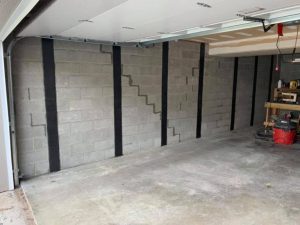
The most common sign of a bowing wall is a horizontal crack running along a mortar joint, usually about three to four courses of block down from the top. As the soil pushes, the blocks actually pivot. If you place a level or a plumb line against the wall, you may notice the center of the wall is protruding several inches further than the base.
Stair-Step Cracks in Brickwork
If your basement is constructed of brick or concrete block, look at the corners. “Stair-step” cracks that follow the mortar lines often indicate that one section of the wall is under more pressure than another, or that the corners are struggling to hold the shifting weight of the home.
Why Traditional Wall Bracing Often Fails
In the past, the standard “fix” for a bowing wall involved installing heavy I-beams (steel soldiers) vertically against the wall. While this can stop further movement, it has significant drawbacks. Steel beams take up valuable square footage, are unsightly in a finished basement, and do nothing to address the tension within the wall itself. Furthermore, they require drilling into your floor and ceiling joists, which can create new points of stress for the structure.
The Rhino Carbon Fiber Advantage: Aerospace Tech for Your Home
At Aqua Dry, we prefer a “Science-Backed” approach to foundation repair. We utilize Rhino Carbon Fiber, a material originally developed for the aerospace and automotive industries. Carbon fiber is stronger than steel but as thin as a penny.
When we apply Rhino Carbon Fiber straps to your basement walls, they are bonded directly to the foundation with a high-strength epoxy. Because carbon fiber does not stretch, it creates a permanent link between the foundation’s footer and the sill plate of the house. This effectively “locks” the wall in place, preventing any further inward movement. Best of all, these straps are low-profile and can be painted over, leaving your basement looking clean and unobstructed.
Permanent Stabilization: The Aqua Dry Lifetime Warranty
A bowing wall is a serious structural liability that can prevent you from selling your home or, in extreme cases, lead to a total collapse. We believe in our methods so strongly that our foundation stabilization services come with a Lifetime Transferable Warranty. This means that if you ever sell your home, the new owners are protected, providing them with the peace of mind they need to close the deal.
Frequently Asked Questions
How much inward bow is considered “dangerous”?
Any movement over 2 inches is considered a critical structural failure that requires immediate intervention. However, even a deflection as small as 1/4 inch indicates that the hydrostatic pressure has already overcome the strength of your masonry, and the problem will only get worse with the next heavy rain.
Does carbon fiber repair require excavation?
No. One of the primary benefits of the Rhino Carbon Fiber system is that it is installed entirely from the interior. There is no need to dig up your landscaping, porches, or driveways to stabilize the wall, making it a faster and less intrusive solution than traditional methods.
Will bowing walls affect my home’s resale value?
Yes, significantly. Most home inspectors will immediately flag a bowing wall as a major defect. However, a professionally repaired wall with a transferable warranty from a certified installer like Aqua Dry actually restores that value and removes the liability during the inspection process.
Protect your home’s structural integrity. Contact Aqua Dry Basement Waterproofing today for a professional foundation stabilization estimate in NJ or PA.

20 + years of experience! – It’s hard to find another company like ours. Our team of experts have decades of experience in residential and commercial construction, plumbing, masonry, and carpentry skills. Not just waterproofing …
5 Star Customer Satisfaction Guarantees! – We receive many compliments on our level of professionalism, cutting edge materials, hard working crews, cleanliness, and customer service: which is something hard to find in our industry. Our goal is to exceed your expectations from start to finish! We are here to alleviate your anxiety and will work our hardest to make sure that all of your concerns are achieved 100%.
