

For homeowners in the Delaware Valley—spanning from the historic streets of Philadelphia to the suburban landscapes of Bucks, Montgomery, and Burlington Counties—heavy rain is a way of life. Our region is prone to sudden, violent thunderstorms and lingering tropical remnants that can dump inches of rain in a matter of hours. In these moments, your primary sump pump is the only thing standing between a dry basement and a costly disaster.
But what happens when the power goes out? In the Delaware Valley, severe storms and utility failures often go hand-in-hand. If your primary pump loses power or suffers a mechanical failure during a flood, a backup system is your last line of defense. At Aqua Dry Basement Waterproofing, we help residents choose between the two industry standards: Battery-Powered and Water-Powered backups. Here is how they compare in our local climate.
The Storm Season Reality: When the Grid Goes Down, the Water Goes Up
The Delaware Valley presents a unique challenge for basement drainage. Many homes in areas like Yardley, PA, or Cherry Hill, NJ, sit on high water tables or clay-heavy soil that retains moisture long after a storm has passed. During a power outage, hydrostatic pressure continues to build. Without a backup system, water can seep through the floor-wall joint or overflow the pit in minutes. A backup pump isn’t just an “extra” feature; it is an insurance policy for your home’s finished basement and structural integrity.
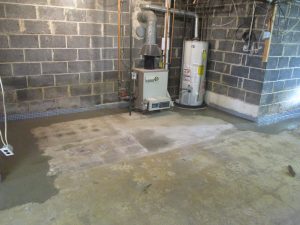
Battery Backup Systems: Pros, Cons, and Lifespans
Battery-powered backup pumps are the most common choice for modern homeowners. These systems utilize a dedicated heavy-duty battery (similar to a car battery but designed for deep-cycle use) to power a secondary pump sitting in your sump pit.
The Advantages
- Universal Compatibility: They work in any home, regardless of whether you have municipal water or a private well.
- High Flow Rates: Modern DC-powered backup pumps, like those in the Pro-Series line we install at Aqua Dry, can move thousands of gallons per hour, keeping up with even the most intense deluges.
- Smart Monitoring: Many systems now feature WiFi alerts, texting you the moment the backup system activates or if the battery requires maintenance.
The Drawbacks
The primary limitation is run-time. A battery has a finite amount of energy. If the power is out for several days and the pump is cycling frequently, the battery will eventually drain. Additionally, these batteries typically need to be replaced every 3 to 5 years to ensure reliability.
Water-Powered Backups: The “Infinite” Solution
Water-powered backup pumps are a unique engineering feat. They do not use electricity or batteries at all. Instead, they use the pressure from your home’s municipal water supply to create a vacuum (the Venturi effect) that sucks water out of the sump pit and ejects it outside.
The Advantages
- Unlimited Run-Time: As long as your city water is running, the pump will work. It doesn’t matter if the power is out for two hours or two weeks.
- Low Maintenance: Since there are no batteries to fail or chemicals to leak, these systems can sit dormant for years and still work perfectly when needed.
The Constraints
Water-powered pumps require a high-pressure municipal water connection. They are not an option for homes on well water, as a power outage would disable the well pump. They also require significant plumbing work to install, as a dedicated 3/4-inch water line must be run to the sump pit.
Which is Best for the Delaware Valley?
At Aqua Dry, we generally recommend High-Output Battery Backup Systems for the majority of our clients in PA and NJ. The reason is simple: modern battery technology has become incredibly reliable, and the ease of installation makes them more cost-effective for most residential foundations. However, if you live in a high-flood zone with municipal water and frequent long-term power outages, a water-powered system offers unparalleled peace of mind.
FAQ
How long does a battery backup pump last?
A fully charged high-quality battery can typically provide 6–12 hours of continuous pumping. Since pumps usually cycle on and off, this often translates to 2–3 days of protection during a standard storm-related outage.
Can I install a water-powered backup if I have well water?
No. Water-powered pumps rely on the pressure from the city’s water main. If you have a well, your water pressure is generated by an electric pump. If the power goes out, your water pressure disappears, rendering the backup useless.
Do these systems require a second discharge line?
While some installers “T” the backup into the main discharge line, Aqua Dry recommends a dedicated second discharge line. This prevents a clog in the main pipe from disabling both your primary and backup pumps simultaneously.
Is your basement one storm away from a disaster? Contact Aqua Dry Basement Waterproofing to upgrade your sump pump system and protect your home today.

20 + years of experience! – It’s hard to find another company like ours. Our team of experts have decades of experience in residential and commercial construction, plumbing, masonry, and carpentry skills. Not just waterproofing …
5 Star Customer Satisfaction Guarantees! – We receive many compliments on our level of professionalism, cutting edge materials, hard working crews, cleanliness, and customer service: which is something hard to find in our industry. Our goal is to exceed your expectations from start to finish! We are here to alleviate your anxiety and will work our hardest to make sure that all of your concerns are achieved 100%.