
Discover why foundation walls deflect inward under pressure and why advanced carbon fiber technology offers a superior structural solution over traditional steel beams.
Why Is My Foundation Wall Tilting or Bowing Inward?
For homeowners across southeastern Pennsylvania, a basement is often more than just a storage area—it is the structural bedrock of the entire house. However, walking down your basement stairs and noticing a visible inward tilt, curve, or horizontal crack along the masonry grid can cause immediate panic. This structural movement is a relatively common phenomenon in Bucks County, heavily driven by regional geological characteristics and intense local weather patterns.
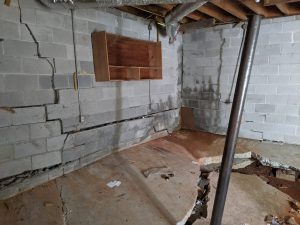
The root cause of this movement is a powerful force known as lateral hydrostatic pressure. The soils surrounding local foundations contain high concentrations of dense clay. When heavy Mid-Atlantic rainstorms or seasonal snowmelts saturate the earth, these clay-heavy soils act like an expanding sponge, swelling violently and trapping thousands of gallons of water against your below-grade concrete. This waterlogged earth exerts massive structural pressure against your basement walls. Over time, when this load exceeds the physical weight and strength of the concrete blocks or poured concrete, the wall begins to deflect inward along its weakest point—typically triggering a long, horizontal crack right through the middle mortar joint.
The Structural Dilemma: Old-School Steel vs. Advanced Engineered Materials
Once a foundation wall bows inward by even an inch, its vertical load-bearing capacity is severely compromised, requiring permanent stabilization to prevent eventual failure. Historically, foundation repair contractors relied heavily on structural steel to brace the masonry from the inside. Today, structural engineering has advanced significantly, presenting homeowners with a critical choice: traditional steel I-beams or high-tensile carbon fiber reinforcement straps.
The Old Way: Heavy Steel I-Beams
Traditional structural stabilization relies on thick, industrial steel I-beams positioned vertically along the inside of the bowing wall. While steel beams are undoubtedly strong, their physical installation is highly intrusive, disruptive, and structurally aggressive.
Intrusive Structural Modification
To secure a steel I-beam, technicians must jackhammer into your basement’s concrete floor slab to anchor the base of the heavy beam directly into the sub-floor footer. The top of the steel beam is then bolted to the heavy floor joists above. This process creates significant noise, vibration, and dust throughout the entire living structure during installation.
Loss of Usable Square Footage
Because structural steel beams must stand perfectly plumb, they cannot conform to the inward curve of the existing bow. As a result, they project several inches directly into your basement area. This layout permanently steals usable square footage and makes finishing your basement virtually impossible, completely ruining any future plans for a clean home office, playroom, or media center.
The Advanced Alternative: Rhino Carbon Fiber Straps
Recognizing the limitations of heavy steel bracing, modern foundation engineering turned to the identical high-tensile material used in aerospace and high-performance racing: carbon fiber. Aqua Dry utilizes the state-of-the-art Rhino Carbon Fiber Structural Stabilization System to permanently halt foundation movement without disruptive interior destruction.
Aerospace Strength Without the Bulk
Carbon fiber features a tensile strength that is nearly ten times stronger than that of structural steel. When bonded directly to a concrete wall, it completely restricts the masonry from flexing, stretching, or shifting inward. Rather than trying to fight the wall with sheer weight, carbon fiber links the top sill plate directly to the foundation footer, distributing the lateral pressure evenly across the entire surface area.
A Sleek, Invisible Architectural Finish
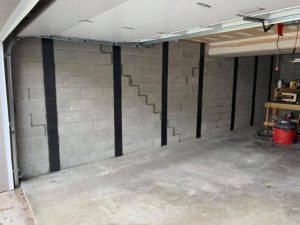
The entire carbon fiber strap lies completely flat against your concrete block or poured wall, measuring less than a fraction of an inch in thickness. Because it conforms directly to the surface, it takes up zero usable floor space. The strap features a smooth texture that can be easily painted over or hidden behind standard drywall framing, leaving your basement perfectly prepared for a beautiful finished design.
Zero Destructive Floor Excavation
Unlike steel beams, carbon fiber stabilization requires absolutely no jackhammering of your concrete floor slab. The straps are secured using a high-strength structural epoxy matrix, bonding permanently with the cellular profile of your foundation walls in a fraction of the installation time.
Frequently Asked Questions
Is a bowing basement wall a structural emergency?
Yes. A bowing basement wall should always be evaluated by a foundation repair specialist as soon as possible.
A wall that bows inward has already lost part of its original structural alignment. As hydrostatic pressure and expanding clay soils continue pushing against the foundation, the wall can continue moving inward, causing larger cracks, water intrusion, reduced structural stability, and significantly higher repair costs.
Early stabilization is almost always less invasive and more affordable than waiting until the wall requires reconstruction or replacement.
What causes basement walls to bow inward?
Hydrostatic pressure from saturated soil is the leading cause of bowing basement walls.
In Bucks County and throughout southeastern Pennsylvania, clay-rich soils absorb large amounts of water during heavy rainfall and snowmelt. As the soil expands, it creates continuous lateral pressure against basement walls. Over time, this pressure can produce horizontal cracks, inward movement, and structural instability if the wall is not permanently reinforced.
Why are carbon fiber straps better than steel I-beams?
Carbon fiber straps permanently stabilize bowing foundation walls without sacrificing usable basement space.
Unlike steel I-beams, carbon fiber reinforcement bonds directly to the foundation wall using high-strength structural epoxy. The straps are extremely thin, require no floor excavation, and distribute structural loads across the wall instead of relying on bulky vertical bracing.
Additional advantages include:
- No jackhammering of the basement floor
- Faster installation
- Zero loss of floor space
- Paintable finish
- Compatible with finished basements
- Long-term structural reinforcement
Can you finish a basement after installing carbon fiber straps?
Yes. Carbon fiber reinforcement is specifically designed to preserve usable basement space.
Because Rhino Carbon Fiber straps sit nearly flush against the wall, standard wood or steel framing can be installed directly over them. Drywall, insulation, and finished wall systems can typically be added without modifying your basement design or losing valuable square footage.
Will carbon fiber straps straighten my bowing wall?
No. Carbon fiber straps are designed to permanently stop additional movement—not push the wall back into place.
Once a foundation wall has bowed inward, the primary objective is to stabilize it before the damage becomes more severe. In situations involving significant displacement, additional structural correction methods may be recommended before carbon fiber reinforcement is installed.
Does homeowners insurance cover bowing foundation walls?
Usually not.
Most homeowners insurance policies exclude damage caused by hydrostatic pressure, groundwater, expanding soils, or normal earth movement. Because every policy is different, homeowners should verify coverage with their insurance provider.
To make structural repairs more affordable, Aqua Dry Basement Waterproofing offers flexible financing options for qualified homeowners.
How do I know if my basement wall needs professional repair?
You should schedule a professional foundation inspection if you notice:
- Horizontal cracks in concrete block walls
- Basement walls bowing or leaning inward
- Stair-step cracking in masonry
- Water seepage through foundation walls
- Doors or windows becoming difficult to open
- Cracking that appears to be growing over time
A professional inspection can determine whether the wall is stable, actively moving, or requires immediate structural reinforcement.
Conclusion
A bowing basement wall is more than a cosmetic issue it is a warning sign that your home’s structural integrity may be under increasing pressure. The sooner the problem is identified, the more repair options are typically available and the lower the likelihood of extensive structural damage.
Modern carbon fiber reinforcement provides homeowners with a permanent, low-profile solution that stabilizes foundation walls without bulky steel beams, disruptive floor excavation, or the loss of valuable basement space. When installed by experienced foundation specialists, carbon fiber straps deliver long-term structural performance while preserving your home’s future value.
If you’ve noticed horizontal cracks, inward wall movement, or other signs of foundation distress, don’t wait for the damage to worsen. Contact Aqua Dry Basement Waterproofing today to schedule your Free 21-Point Structural Foundation Inspection. Our experienced team will identify the source of the problem, explain your repair options, and recommend the most effective long-term solution to protect your home for years to come.

20 + years of experience! – It’s hard to find another company like ours. Our team of experts have decades of experience in residential and commercial construction, plumbing, masonry, and carpentry skills. Not just waterproofing …
5 Star Customer Satisfaction Guarantees! – We receive many compliments on our level of professionalism, cutting edge materials, hard working crews, cleanliness, and customer service: which is something hard to find in our industry. Our goal is to exceed your expectations from start to finish! We are here to alleviate your anxiety and will work our hardest to make sure that all of your concerns are achieved 100%.
