

Over 50% of our projects involve tearing out and replacing failed competitor designs. Learn why standard sub-floor drainage systems clog and how to secure a permanent fix.
The Double Expense: Fixing a “Fixed” Basement
There are few homeowner experiences more deeply frustrating than investing thousands of hard-earned dollars into a professional basement waterproofing system, finishing the space into a beautiful home office or play area, and then walking downstairs after an East Coast storm only to find soggy carpets and standing water. It feels like a complete betrayal of trust. However, if you are currently facing a wet basement despite having an interior drainage system or French drain installed, you are far from alone.
At Aqua Dry Basement Waterproofing, a staggering 50% of our daily operational volume across southeastern Pennsylvania and southern New Jersey doesn’t involve working on raw, untreated basements. Instead, it consists of tearing out, re-engineering, and replacing failed, clogged, or poorly designed systems installed by other contractors. The hard truth of below-grade water management is that water tables and subterranean soil dynamics are relentlessly aggressive. If a system is built using cheap, generic materials or incorrect physical tolerances, it has a strict expiration date.

The Three Most Common Fatal Design Flaws
When an interior sub-floor waterproofing system fails, the culprit is almost never a lack of water; it is a fundamental breakdown in filtration and mechanical flow. Across the Tri-State corridor, soil composition shifts from heavy clay to fine, sandy silt. When these geofactors collide with standard builder-grade waterproofing setups, three distinct engineering failures consistently occur:
1. Silt Overwhelm and Crushed Corrugated Pipes
The most common material used by high-volume, low-cost waterproofing companies is flexible, black corrugated plastic piping. This pipe is cheap to manufacture and fast to install, but its physical design is fatally flawed for subterranean use. The ridges and valleys inside corrugated pipe act like miniature speed bumps, catching and trapping the fine dirt, silt, and clay particles that wash in with groundwater. Over a few short years, this sediment settles in the ridges, slowly choking off the water channel until the pipe is entirely impacted with mud. Furthermore, these flexible pipes have incredibly low structural crush ratings; as local soils shift and settle under hydrostatic pressure, the pipe can easily flatten, completely blocking water flow to the sump pit.
2. Iron Ochre and Bacterial Slime Buildup
In many regions of Bucks County, PA, and Mercer County, NJ, the groundwater carries high concentrations of dissolved iron. Certain subterranean microorganisms feed on this iron, triggering a biological reaction that creates a thick, gelatinous orange slime known as iron ochre. This sludge is incredibly sticky and adheres to everything it touches. Standard waterproofing systems utilize fine-woven fabric filters or open-backed tracks sitting underneath the concrete floor slab. Iron ochre quickly seals these fabrics and tiny drainage holes, forming a solid, waterproof crust. Once the paths are blocked, rising groundwater cannot enter the drainage track, leaving it with no choice but to push upward through the cold joints of your floor slab.
3. Unprotected, Single-Pump Configurations
Your sub-floor drainage network is only as capable as its mechanical exit point: the sump pump. Many budget installations cut corners by deploying a single, residential-grade plastic sump pump inside an unsealed basin. This creates a critical single point of failure. If an intense summer downpour triggers a local electrical grid blackout, a single pump immediately dies. Even if the power stays on, a primary pump operating continuously during a severe storm faces immense mechanical strain and can burn out without warning, resulting in immediate lower-level flooding.
The Aqua Dry Standard: Engineering a Clog-Free System
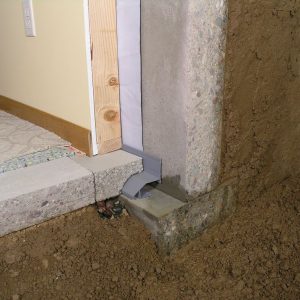
Correcting a failed waterproofing system requires moving away from flexible materials and unmanaged paths and shifting toward rigid, industrial-grade flow mechanics. Aqua Dry permanently resolves below-grade system failures by completely re-engineering the sub-floor blueprint.
Instead of cheap corrugated tubing, we install smooth-walled, heavy-gauge diagnostic conduits. These rigid pipes feature a mirror-smooth interior surface that maintains a high velocity of water flow, naturally flushing out fine silt particles before they can settle. Additionally, our drainage arrays are designed with large, engineered intake slots that resist iron ochre binding, ensuring that water can always enter the channel easily.
To eliminate mechanical failure, we build absolute redundancy into our sump basins. We deploy dual-pump configurations consisting of a primary heavy-duty cast-iron pump paired with a secondary backup pump. This entire array is connected to a smart battery fail-safe system that monitors performance in real time. If the primary pump fails or the local power grid goes down, the secondary battery-powered pump engages instantly, keeping your basement dry through the worst Mid-Atlantic weather events. This level of engineering allows us to confidently back our systems with an authentic, Lifetime Transferable Warranty that protects your family and preserves your home’s equity for future buyers.
Frequently Asked Questions
Can a clogged interior French drain system be flushed clean?
In rare instances where a system is clogged by loose surface debris near an open basin, temporary flushing might offer minor relief. However, if a corrugated pipe buried beneath your concrete floor is completely impacted with packed mud or thick iron ochre sludge, flushing cannot clear it; the only permanent solution is full excavation and replacement with a smooth-bore system.
What exactly is iron ochre, and can it be chemically treated?
Iron ochre is a thick, orange, gelatinous slime produced by iron-oxidizing bacteria in groundwater. There is no safe chemical flush that can permanently dissolve it within a sub-floor drain without destroying concrete components. The only effective defense is installing a specialized, smooth-walled drainage conduit designed with large clog-resistant intake portals and accessible cleanout flush-ports.
How long should a professionally installed basement waterproofing system last?
A poorly filtered, budget system built with flexible materials can clog and fail in less than 5 years. Conversely, an engineered, smooth-bore rigid system installed by the certified specialists at Aqua Dry is designed to keep your foundation protected for its entire structural lifecycle.
Don’t pay for the exact same waterproofing job twice. If your current basement system is failing to keep your home dry, secure an engineered solution built to last a lifetime. Contact Aqua Dry Basement Waterproofing today to schedule your comprehensive, Free 21-Point Advanced Drainage Forensic Review.

20 + years of experience! – It’s hard to find another company like ours. Our team of experts have decades of experience in residential and commercial construction, plumbing, masonry, and carpentry skills. Not just waterproofing …
5 Star Customer Satisfaction Guarantees! – We receive many compliments on our level of professionalism, cutting edge materials, hard working crews, cleanliness, and customer service: which is something hard to find in our industry. Our goal is to exceed your expectations from start to finish! We are here to alleviate your anxiety and will work our hardest to make sure that all of your concerns are achieved 100%.
