For homeowners across Pennsylvania and New Jersey, discovering cracks in a basement wall is a common point of anxiety. While small, vertical hairline cracks often result from natural concrete curing or minor settling, horizontal cracks and inward wall bowing signal a far more serious issue: structural failure under pressure.
Your foundation supports the entire weight of your home. When subterranean forces cause foundation walls to deflect inward, ignoring the early warning signs can lead to costly structural repairs or even complete wall collapse. Understanding why foundation walls bow, how to identify critical failure signs, and how modern engineering fixes the problem permanently is key to protecting your property’s safety and value.
Recognizing the Warning Signs of Structural Wall Failure
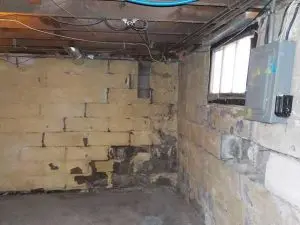 Foundation walls rarely fail overnight. They usually give clear visual indicators as subterranean pressures build up over time. Homeowners should look out for these key symptoms:
- Horizontal Cracks Parallel to the Floor: A horizontal crack running mid-height along a cinder block or poured concrete wall is the single most definitive sign of lateral pressure damage.
- Inward Bowing, Shearing, or Bulging: Cinder block walls often crack along mortar joints and bow inward near the center, while poured concrete walls tend to tilt inward from the top or shear at the bottom seam.
- Stair-Step Cracks in Masonry: In block foundations, cracks frequently follow the mortar lines in a diagonal stair-step pattern near wall corners.
- Operational Issues Upstairs: As the foundation shifts, door frames on the first floor may stick, windows may jam, and floorboards may become noticeably unlevel.
The Root Cause: Expansive Clay Soil and Lateral Hydrostatic Pressure
The primary driver behind bowing foundation walls in the Mid-Atlantic region is lateral hydrostatic pressure combined with expansive clay soils.
During heavy rainfall or seasonal snowmelt, dense clay soil absorbs massive amounts of water and expands like a sponge. This expansion exerts thousands of pounds of lateral force against subterranean foundation walls. During winter, repeated freeze-thaw cycles cause wet soil near the surface to expand even further, driving frost-heave pressure against upper foundation courses.
Over decades of continuous wet-dry expansion cycles, unreinforced concrete block and poured walls reach a yield point. Mortar joints snap, concrete cracks, and the wall begins bowing inward toward the path of least resistance: your open basement space.
Modern Repair Technologies: Stopping Wall Movement for Good
Historically, fixing a bowing wall meant excavating the entire yard with heavy machinery and rebuilding the masonry from scratch. Today, advanced structural engineering allows contractors to stabilize and reinforce bowing foundation walls from the inside quickly and cleanly.
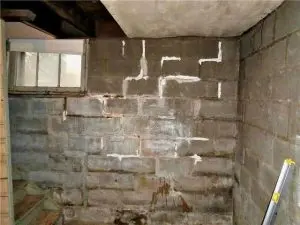 1. Carbon Fiber Wall Reinforcement
For walls with minimal deflection (typically bowing less than 2 inches), space-age carbon fiber straps provide a clean, non-obtrusive fix. Carbon fiber straps are bonded directly to the wall surface using high-strength epoxy. Because carbon fiber boasts a tensile strength far exceeding steel, it permanently seals cracks and stops inward movement instantly without taking up living space.
2. Heavy-Duty Steel Wall Anchors & I-Beams
For severe wall deflection (bowing more than 2 inches) or structural shearing, heavy-duty steel wall anchor systems or vertical steel I-beams (customized structural steel) are anchored directly into the floor slab and overhead floor joists. Wall anchors extend out into stable yard soil to brace the structure, providing the force needed to pull bowed walls back toward plumb over time.
3. Integrating Water Management
Stabilizing the wall mechanically addresses structural strength, but relieving the underlying water pressure is equally vital. Combining structural stabilization with a subterranean sub-slab perimeter drainage system guarantees that hydrostatic water pressure is safely drained away before it can build up behind the wall again.
Frequently Asked Questions
Can a bowing foundation wall be pushed back into place?
Yes. Depending on the construction material, severity of deflection, and system used, heavy-duty wall anchor systems can be tensioned over time to pull, or jack bowed masonry walls back toward their original alignment.
How do carbon fiber straps work to repair foundation walls?
Carbon fiber straps are engineered polymers bonded with specialized epoxy resins to create an unbreakable bond across mortar joints and cracks. Once installed, the high tensile strength prevents the wall from expanding or bowing inward further, effectively locking the foundation in place.
Does homeowner insurance cover bowing basement wall repairs?
Standard homeowner policies generally exclude structural damage caused by hydrostatic pressure, ground settlement, or soil expansion. Investing in certified structural repair early protects your home’s structural stability and resale appraisal value before catastrophic failure occurs.
Protect Your Home Before Minor Foundation Problems Become Major Structural Repairs
Bowing basement walls and horizontal foundation cracks are more than cosmetic issues—they are warning signs that your home’s structural integrity may be under significant stress. The sooner these problems are identified, the more repair options are available, often resulting in less invasive solutions and lower long-term costs.
Whether the cause is hydrostatic pressure, expansive clay soils, or decades of seasonal freeze-thaw cycles, professional evaluation is essential to determine the severity of the damage and recommend the most effective repair strategy. Modern solutions such as carbon fiber reinforcement, steel wall anchors, structural I-beams, and integrated drainage systems can stabilize your foundation, prevent further movement, and help preserve your home’s safety, value, and longevity.
Protect Your Home’s Foundation with Aqua Dry
If you’ve noticed horizontal cracks, bowing basement walls, stair-step cracks, or other signs of foundation movement, don’t wait for the damage to worsen. Early intervention can help prevent more extensive structural repairs and provide greater peace of mind.
Contact Aqua Dry Basement Waterproofing today to schedule a comprehensive 21-Point Structural Inspection. Proudly serving homeowners throughout Pennsylvania, New Jersey, and Delaware, our experienced team provides professional foundation repair and basement waterproofing solutions designed to protect your home for years to come.

20 + years of experience! – It’s hard to find another company like ours. Our team of experts have decades of experience in residential and commercial construction, plumbing, masonry, and carpentry skills. Not just waterproofing …
5 Star Customer Satisfaction Guarantees! – We receive many compliments on our level of professionalism, cutting edge materials, hard working crews, cleanliness, and customer service: which is something hard to find in our industry. Our goal is to exceed your expectations from start to finish! We are here to alleviate your anxiety and will work our hardest to make sure that all of your concerns are achieved 100%.