

That familiar, pungent “basement smell” isn’t just an unpleasant annoyance—it’s a warning sign. For homeowners across Pennsylvania and New Jersey, a damp, musty crawl space often serves as an invisible origin point for poor indoor air quality, structural decay, and unseen health hazards.
When high subterranean humidity settles beneath your first floor, it creates an ideal breeding ground for toxic molds. These organisms don’t just produce microscopic spores; they release volatile organic compounds and toxic chemical byproducts called mycotoxins. Understanding how these airborne pollutants enter your living area—and how full crawl space encapsulation eliminates them—is essential for keeping your home healthy and structurally sound.
The Stack Effect: How Crawl Space Air Reaches Your Living Room
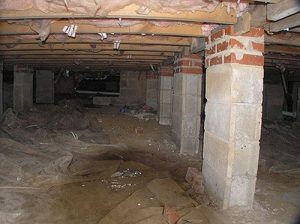
Many homeowners assume that what happens in the crawl space stays in the crawl space. Building physics proves otherwise. Through a continuous natural phenomenon known as the Stack Effect, your home acts like a chimney.
As warm air rises and escapes through upper-story windows, attic vents, and roof seams, it creates a vacuum at the lower levels of the house. This suction pulls air upward from beneath your ground floor. In fact, studies show that up to 50% of the air you breathe on your first floor originated in your basement or crawl space. If your crawl space harbors damp earth, rotting joists, and active mold, those contaminants circulate continuously through your living rooms, kitchens, and bedrooms.
Mold Spores vs. Mycotoxins: What Is Threatening Your Health?
While most people are familiar with mold spores, fewer understand the heightened danger of mycotoxins. Mold spores are the microscopic reproductive seeds released by fungi. Mycotoxins, on the other hand, are toxic chemical compounds produced by specific mold species (such as Stachybotrys chartarum, Aspergillus, and Penicillium) when under environmental stress.
Why Mycotoxins Are Particularly Dangerous
- Extremely Small Size: Mycotoxins are far smaller than mold spores—often less than 0.1 microns in size. This allows them to easily pass through standard furnace air filters and penetrate deep into human lung tissue.
- Persistence in Dust: Unlike living mold spores, toxic mycotoxin particles do not die off when dry; they attach to household dust particles, carpet fibers, and HVAC ductwork, remaining active indefinitely.
- Unexplained Health Symptoms: Chronic exposure to airborne mycotoxins can trigger persistent respiratory irritation, unexplained fatigue, skin rashes, brain fog, and severe allergic reactions in sensitive individuals.
Why Open Crawl Space Vents Worsen the Problem
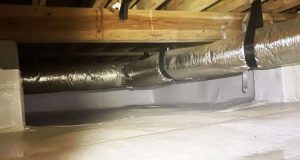
Older building codes required open vents in crawl spaces under the mistaken belief that outside air would circulate and dry out the subterranean space. In the humid Mid-Atlantic climate, this design backfires completely.
During humid spring and summer months, hot outdoor air enters cold crawl space vents. When warm, humid air hits cooler subterranean floor joists and concrete walls, it reaches its dew point and condenses into liquid water. This continuous moisture loop keeps relative humidity levels well above 60%—the exact threshold where mold germinates and wood-destroying fungi begin rotting your floor joists.
The Scientific Solution: Clean Space Encapsulation
To eliminate musty odors and stop mycotoxins from entering your home, you must completely isolate the crawl space from subterranean ground moisture and humid outdoor air.
Key Steps in Crawl Space Encapsulation
- Heavy-Duty Vapor Barrier: High-grade, multi-layer reinforced vapor barriers (up to 20-mil thickness) line the floor and foundation walls, completely sealing off raw earth.
- Sealing Vents & Rim Joists: Exterior air vents are permanently sealed, and rim joists are insulated to stop hot, humid air infiltration.
- Dedicated Dehumidification: A commercial-grade, subterranean dehumidifier keeps relative humidity strictly below 50%, ensuring mold cannot grow or produce mycotoxins.
Frequently Asked Questions
What is the difference between a simple vapor barrier and full encapsulation?
A simple vapor barrier is a thin, unsealed plastic sheet laid loosely on dirt floors, leaving walls and vents open to moisture. Full encapsulation completely seals floors, walls, and vents with heavy-duty reinforced membranes and incorporates continuous humidity control to guarantee dry air.
How do I know if my crawl space has high mycotoxin levels?
Persistent musty odors on the first floor, warped hardwood flooring, visible dark discoloration on floor joists, or chronic indoor allergy symptoms that improve when away from home are strong indicators of mold spores and mycotoxins cycling upward.
How long does it take to encapsulate a crawl space?
Most residential crawl space encapsulations take between 1 and 2 days depending on square footage, debris removal, and whether structural joist repairs or jack installations are needed.
Breathe Cleaner Air with Aqua Dry Basement Waterproofing: Don’t let hidden subterranean mold compromise your home’s air quality. Contact Aqua Dry today to schedule a comprehensive Crawl Space & Moisture Inspection across Pennsylvania, New Jersey, and Delaware.

20 + years of experience! – It’s hard to find another company like ours. Our team of experts have decades of experience in residential and commercial construction, plumbing, masonry, and carpentry skills. Not just waterproofing …
5 Star Customer Satisfaction Guarantees! – We receive many compliments on our level of professionalism, cutting edge materials, hard working crews, cleanliness, and customer service: which is something hard to find in our industry. Our goal is to exceed your expectations from start to finish! We are here to alleviate your anxiety and will work our hardest to make sure that all of your concerns are achieved 100%.
