

Most homeowners think of basement flooding as a spring and summer problem. Heavy rain arrives, the water table rises, the sump pump works hard, and the basement stays dry. Winter feels safer because the ground is frozen and the rain stops.
In practice, winter is when a basement waterproofing system is most likely to fail without warning. The reason is rarely the pump itself. It is the pipe that carries water away from the pump, and specifically the short stretch of that pipe exposed to freezing air. When the discharge line plugs with ice, everything upstream of it stops working, and the homeowner usually has no idea until water is already on the floor.
This guide explains exactly how a discharge line freezes, what it does to the pump, and the design details that keep the line draining through a Pennsylvania or New Jersey winter.
Why Winter Is the Riskiest Season for a Sump Pump
A sump pump does not stop working in December. Groundwater keeps moving, snow melts, and mid winter rain still falls. What changes is the exit route. For most of the year the discharge line is simply a pipe. For roughly three months a year it is a pipe that can seal itself shut.
The failure is also silent. A dead battery announces itself the moment the power goes out. A frozen line announces nothing at all, because the pump still hums, the float still rises, and every indicator says the system is running. It simply is not moving any water.
How a Discharge Line Actually Freezes
Freezing does not happen evenly along the pipe. It follows a predictable sequence, which is useful because it means the problem is predictable and therefore preventable.
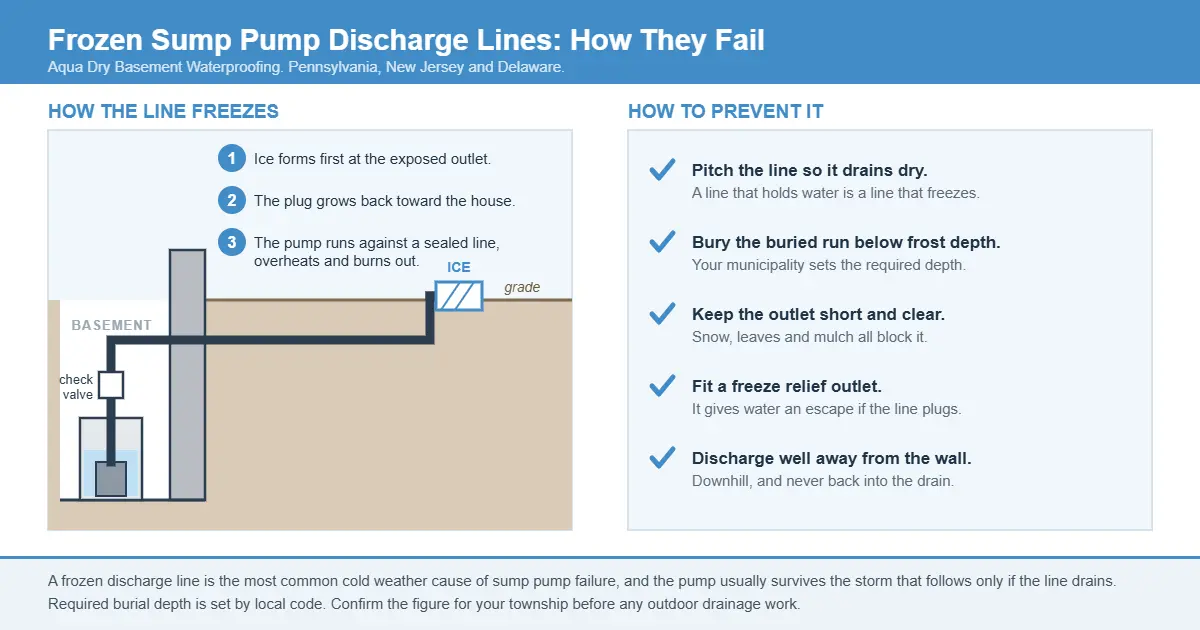
It starts at the outlet. The last few feet of pipe sit above grade in open air, often lying on the lawn. That section has no soil insulating it and loses heat fastest. After the pump shuts off, a small amount of water always remains in the line. At the outlet, that residual water freezes first.
The plug grows backward. Each time the pump cycles, it pushes water against the new ice, and some of that water freezes onto the plug. The obstruction thickens and creeps back toward the house with every cycle. A line that discharged fine on Tuesday can be fully blocked by Friday.
The line seals. Once the plug is continuous, the pump is pushing against a closed pipe. Water has nowhere to go, so it returns to the basin through the check valve or simply stays put, and the basin refills.
Two conditions make this dramatically worse. A line with a low spot or a backward pitch holds standing water instead of draining after each cycle, which gives ice a head start. And a long horizontal run lying on the ground, which is common with add on extensions, presents far more cold surface than a short buried run.
What a Frozen Line Does to the Pump
This is the part that turns an inconvenience into a replacement invoice. A sump pump is cooled by the water moving through it. When the discharge is blocked, the motor keeps running but no water moves, so the pump has no way to shed heat.
- The float keeps calling for the pump because the basin never empties, so the motor runs continuously rather than in short cycles.
- The impeller churns the same water, which heats up quickly.
- Many pumps have a thermal cutoff that shuts the motor down to protect it. The pump then sits idle while the basin fills.
- Pumps without that protection, or pumps whose protection has already worn out, burn out the windings.
Either outcome ends the same way. The basin overflows, water spreads across the floor, and the homeowner discovers it hours later. If a battery backup is installed, it does not help, because the backup pump discharges through the same frozen pipe. This is a point worth understanding alongside our breakdown of why backup batteries fail during storms. A backup protects against power loss. It does nothing about a blocked exit.
Why Pennsylvania and New Jersey Winters Are Especially Hard on Discharge Lines
Our region sits in an awkward climate band for this particular failure. A consistently frozen winter is actually easier on a drainage system than what we get, because the damage comes from repeated crossings of the freezing point rather than from sustained cold.
Repeated freeze and thaw cycling. Temperatures here swing across 32 degrees many times each winter, sometimes within a single day. Each cycle melts part of the plug and refreezes it, and the ice that forms after a partial thaw is denser and harder to clear than the first layer.
Mid winter rain on frozen ground. A January thaw with rain is a worst case. Frozen soil cannot absorb water, so nearly all of it becomes surface runoff, and a large share of that runoff heads for the lowest point available, which is the excavated backfill around your foundation. The pump sees a heavy load at exactly the moment the line is most likely to be blocked.
Snowmelt with nowhere to go. A snowpack holds a substantial volume of water. When it releases over a warm weekend, the ground beneath is often still frozen, and the same runoff problem repeats.
Buried outlets that disappear. Plowed and shoveled snow gets piled wherever there is room, which is frequently the side yard where the discharge exits. An outlet buried under a snow pile cannot drain, and nobody notices until spring.
The Damage Is Not Limited to the Pump
Freezing water expands by roughly nine percent, and it expands with enough force to move masonry. That matters for any existing crack in a foundation wall.
Water enters a hairline crack during a wet spell, freezes, and widens the crack slightly. The wider crack admits more water next time, which freezes and widens it further. Over several winters a cosmetic hairline becomes a genuine leak, and the process accelerates rather than slowing down. This is one of the reasons a small crack is worth sealing before winter rather than after, and why foundation crack repair is often cheaper when it is scheduled rather than urgent.
Saturated soil that freezes also expands against the outside of the foundation wall, adding lateral load on top of the hydrostatic pressure the wall already carries. On a wall that is already showing horizontal cracking or inward movement, winter is not a quiet season.
How to Winterize a Discharge Line Properly
The goal is simple to state and easy to get wrong: the line must be completely empty within a minute of the pump shutting off, and the outlet must stay open.
Pitch the entire run so it drains. Continuous fall from the house to the outlet is the single most effective defense. Any dip, sag, or flat section holds water, and standing water is what freezes. Flexible corrugated extensions are the usual culprit here, because they sag between supports.
Bury the main run below the local frost depth. Soil is an excellent insulator, and a properly buried line stays above freezing even in a hard cold snap. Required depth is set by your municipality rather than by a rule of thumb, so confirm the figure with your township or borough code office before digging.
Keep the above grade portion as short as possible. Every exposed foot is a place for ice to start. Where a long run is unavoidable, a larger diameter outlet section takes noticeably longer to close off than a narrow one.
Install a freeze relief fitting. This is a slotted or vented outlet mounted above grade near the foundation. If the line beyond it freezes or blocks, water escapes through the openings instead of backing up. It will not win any awards for elegance, and it does discharge close to the house, but it keeps the pump alive and the basement dry, which is the entire point.
Terminate well away from the foundation, downhill. Discharging next to the wall simply recirculates the same water back through the system. Aim for a point well clear of the backfill zone, on ground that falls away from the house, and never into a window well or back into the perimeter drain.
Check the check valve. A failed check valve lets the column of water in the riser fall back into the basin after every cycle, which makes the pump work far harder and adds water to the line at the worst time.
A Short Pre Winter Checklist
Late September through October is the right window for this. Everything here takes an afternoon.
- Walk the discharge line end to end and find the outlet. A surprising number of homeowners have never located theirs.
- Pour a bucket of water into the sump basin and confirm the pump runs, moves water, and shuts off cleanly.
- Watch the outlet while it runs, then check it a minute after shutoff. It should be draining, then dry.
- Clear leaves, mulch, soil, and debris from the outlet, and mark it with a stake so it is visible after snowfall.
- Remove or re pitch any sagging extension.
- Tell whoever plows or shovels where not to pile snow.
- Seal visible foundation cracks before the first hard freeze.
- Clean the basin, since buildup on the float is what turns a cold snap into a failure. Our guide to iron ochre in basement drains covers what that buildup is.
Frequently Asked Questions
Should I disconnect my sump pump discharge line for the winter?
No. The pump still needs somewhere to send water, and groundwater does not stop moving because it is cold. Disconnecting the line means discharging at the foundation wall, which sends the same water straight back into the system it just left. What you should remove is any sagging seasonal extension that holds standing water, and replace it with a properly pitched run.
How can I tell whether my discharge line is already frozen?
Listen to the pump. A healthy cycle is short, and you can hear water leaving. A pump that runs long, cycles again almost immediately, or runs without any sound of water moving is a strong signal. Then go outside and look at the outlet while the pump is running. If nothing comes out, the line is blocked. Unplug the pump before investigating further so it is not running dry against the obstruction while you work.
Can I thaw a frozen discharge line myself?
Sometimes, if the blockage is in the exposed section near the outlet. Warm water poured over the outside of the pipe and patience will often open it. Do not use an open flame on plastic pipe, and do not attempt to force the plug out with pressure. If the ice extends into the buried run, there is no safe way to reach it from the outside, and the practical fix is a temporary alternate discharge path until a permanent one can be built.
Will a battery backup protect me from this?
Not on its own. A battery backup solves a power problem. A frozen line is a plumbing problem, and in most installations the backup pump uses the same discharge pipe as the primary. If that pipe is blocked, both pumps are equally stuck. The two protections are complementary rather than interchangeable, and a home in a high water table area really wants both.
Does homeowners insurance cover a basement flood caused by a frozen line?
It depends entirely on your policy and on how the loss is classified. Sump pump failure and water backup are commonly excluded from standard policies unless a specific endorsement has been added, and groundwater intrusion is treated differently from a burst supply pipe. Read your declarations page, and speak to your agent before you need to. This is a question worth answering in October rather than in February.
Get the Line Checked Before the First Hard Freeze
A frozen discharge line is one of the few basement failures that is almost entirely preventable with design rather than equipment. The pump in your basin is probably fine. The pipe leaving it is where the winter risk actually lives, and it is usually the part nobody looks at.
If your pump runs longer than it used to, if you have never found your outlet, if the line lies on the lawn, or if last winter ended with water on the floor and no clear explanation, the discharge route is the first place to look.
Contact Aqua Dry Basement Waterproofing today to schedule a comprehensive 21-Point Inspection. We will test the pump under load, trace and evaluate the full discharge route, check the pitch and the outlet, and recommend a drainage solution built to keep running through a Mid Atlantic winter. Proudly serving homeowners throughout Pennsylvania, New Jersey, and Delaware.

20 + years of experience! – It’s hard to find another company like ours. Our team of experts have decades of experience in residential and commercial construction, plumbing, masonry, and carpentry skills. Not just waterproofing …
5 Star Customer Satisfaction Guarantees! – We receive many compliments on our level of professionalism, cutting edge materials, hard working crews, cleanliness, and customer service: which is something hard to find in our industry. Our goal is to exceed your expectations from start to finish! We are here to alleviate your anxiety and will work our hardest to make sure that all of your concerns are achieved 100%.