

Learn how to distinguish harmless mineral deposits from toxic mold growth on your basement walls—and fix the underlying moisture issue permanently.
Discovering a powdery white substance on your basement or crawl space foundation walls can be alarming for any homeowner. Is it a hazardous mold infestation that threatens your family’s health, or is it simply a benign mineral reaction? While white mold and efflorescence look remarkably similar at first glance, they are fundamentally different in composition, origin, and risk level.
However, both share one critical root cause: unmanaged water intrusion. Whether you are dealing with organic fungal growth or inorganic salt deposits, white powder on concrete, brick, or cinder block walls is a clear warning sign that hydrostatic pressure is forcing moisture into your foundation. Understanding the difference between efflorescence and white mold is the first step toward restoring your home’s indoor air quality and structural stability.
What is Efflorescence?
Efflorescence is an inorganic salt deposit left behind when water evaporates from porous masonry materials like concrete, brick, mortar, or stone. As groundwater moves through foundation walls via capillary action, it dissolves natural water-soluble minerals—such as calcium, sodium, and potassium—present within the concrete matrix.
When this moisture reaches the interior basement wall surface and evaporates into the air, it leaves behind a chalky, crystalline residue. While efflorescence itself is non-toxic and does not rot building materials, it serves as a visual indicator that water is continuously migrating through your foundation walls under hydrostatic pressure.
What is White Mold?
Unlike efflorescence, white mold is an organic living organism. Fungal species like Penicillium, Aspergillus, and Cladosporium can appear white during their early growth stages before developing darker pigmentation. Mold requires three elements to thrive: moisture, oxygen, and an organic food source.
While concrete itself is inorganic, mold feeds on organic material resting on or near foundation walls—including dust, efflorescence-trapped dirt, drywall, wood furring strips, carpet fibers, and paint coatings. Left unchecked, white mold releases airborne microscopic spores that aggravate respiratory issues, trigger allergies, and deteriorate surrounding building materials.
How to Tell the Difference: The Comparison Guide
You can quickly identify whether the white residue on your foundation walls is efflorescence or white mold using a few simple observations and tests:
| Characteristic | Efflorescence | White Mold |
|---|---|---|
| Material Type | Inorganic salt residue | Organic living fungus |
| Substrate Location | Grows strictly on masonry, concrete, and brick | Grows on wood, drywall, paint, and dirty concrete |
| Texture & Structure | Chalky, powdery, or hard crystalline crust | Soft, fuzzy, velvety, or thread-like structure |
| Water Test Reaction | Dissolves instantly when sprayed with water | Repels water or remains clumped together |
| Pinch Test | Breaks down into fine, abrasive powder | Smears and feels soft or slimy between fingers |
| Odor | Odorless | Musty, damp, or earthy smell |
Addressing the Root Cause: Permanent Water Control
Scraping away efflorescence or spraying white mold with bleach offers only short-term cosmetic relief. As long as ground moisture penetrates your foundation walls, both salt deposits and fungal colonies will repeatedly return—eventually causing surface spalling, wall cracking, and indoor air degradation.
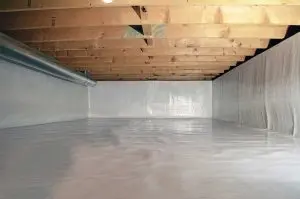
To eliminate white powder on basement walls permanently, you must stop water intrusion before it reaches the interior masonry. A comprehensive structural approach typically includes:
- Interior Drainage Systems: Installing a sub-floor interior French drain system to relieve hydrostatic pressure beneath the slab and direct wall seepage safely into a sump pump.
- Vapor Wall Membranes: Mounting continuous heavy-duty vapor barriers along lower foundation walls to channel moisture downward into subsurface drains while keeping wall surfaces dry.
- Dehumidification: Operating commercial-grade basement dehumidifiers to keep relative humidity below 50%, halting mold spore germination.
Get a Professional Foundation Inspection
Whether the white residue on your walls turns out to be chalky mineral deposits or toxic mold, ignoring the warning signs allows hidden water pressure to erode your foundation over time. Protecting your home requires a targeted, permanent waterproofing strategy.
Not sure what is growing on your foundation walls? Contact our basement waterproofing specialists today for an expert moisture diagnostic and no-obligation repair estimate.

20 + years of experience! – It’s hard to find another company like ours. Our team of experts have decades of experience in residential and commercial construction, plumbing, masonry, and carpentry skills. Not just waterproofing …
5 Star Customer Satisfaction Guarantees! – We receive many compliments on our level of professionalism, cutting edge materials, hard working crews, cleanliness, and customer service: which is something hard to find in our industry. Our goal is to exceed your expectations from start to finish! We are here to alleviate your anxiety and will work our hardest to make sure that all of your concerns are achieved 100%.