

A damp basement is manageable while you live in a house. It becomes a very different problem the moment you decide to sell it, because the basement stops being your private inconvenience and becomes a line item in somebody else’s inspection report.
Sellers across Pennsylvania and New Jersey tend to handle this one of two ways. Some spend money fixing things a buyer would never have flagged. Others say nothing, get through the first showing, and then watch the deal stall at the inspection. Both outcomes come from the same gap, which is not knowing what a buyer inspector actually looks for and what you are actually obligated to say.
Here is how the basement is evaluated during a sale, what disclosure generally involves in both states, and how to decide between fixing the problem and pricing around it.
One note before anything else. This article is general information, not legal advice. Disclosure duties vary by state, by contract, and by situation. Confirm your specific obligations with your listing agent or a real estate attorney before you complete any disclosure form.
What a Buyer Inspector Actually Looks For
Home inspectors are not waterproofing contractors, and most will not tell a buyer how to fix anything. What they do is document evidence of past or present water. That documentation is what the buyer and their agent then use to negotiate.
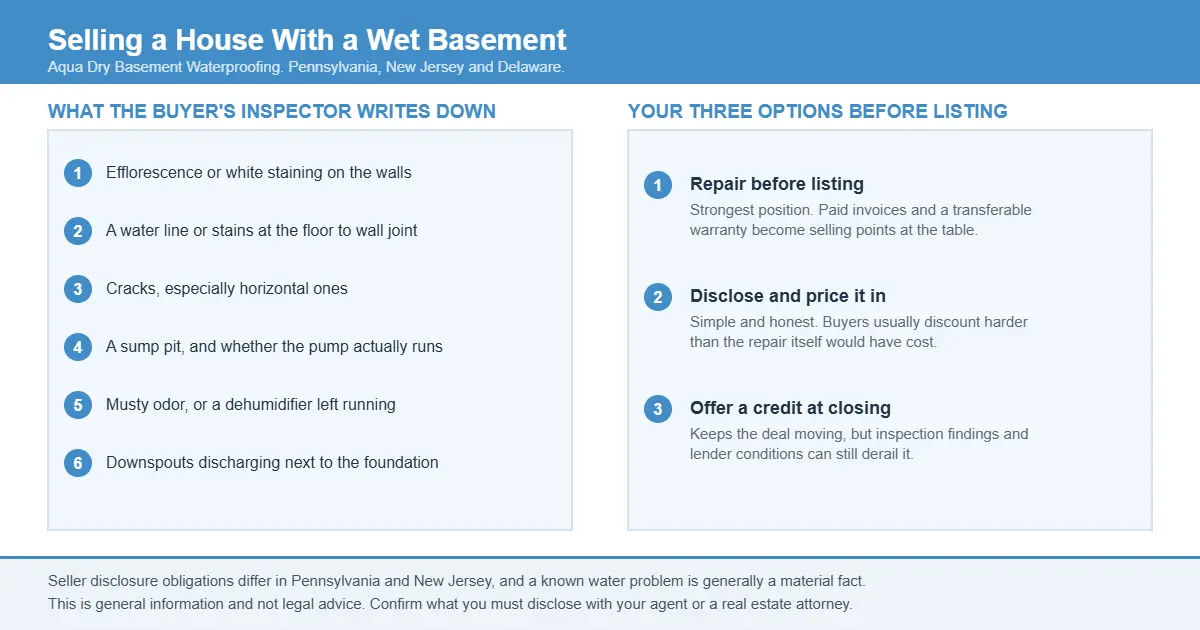
White mineral staining on the walls. Efflorescence is the powdery white deposit left behind when water passes through masonry and evaporates. It is not mold and it is not dangerous, but it is physical proof that water has moved through the wall. Scrubbing it off before a showing does not help, because it returns and because an inspector reads a freshly cleaned foundation wall as a signal in itself.
Staining at the floor to wall joint. The cove joint where the wall meets the slab is the most common entry point in a basement, and it leaves a distinct horizontal line. Inspectors look for it behind stored boxes and along finished walls.
Cracks, with horizontal ones treated very differently. A thin vertical crack is usually normal curing or minor settlement. A horizontal crack suggests the wall is under lateral load, which turns a water note into a structural note and frequently triggers a request for a specialist evaluation. Our guide on bowing walls and horizontal cracks explains why.
The sump pit, and whether the pump works. Many inspectors test the pump by lifting the float. They note a pit with no pump, a pump that does not start, a pit with a visible water line well above normal, and a discharge line that goes nowhere useful.
Odor and humidity. A musty smell is noted even with nothing visible, because it indicates moisture somewhere. A dehumidifier running during the inspection is read as a sign the basement needs help staying dry.
What is happening outside. Downspouts that end at the foundation, soil graded toward the house, and window wells full of debris all get written up. These are cheap to correct and they shape the inspector’s overall impression before they ever reach the basement.
One thing worth understanding: a finished basement does not hide any of this. Inspectors are trained to look for patched drywall, replaced baseboard, flooring that stops short of a wall, and fresh paint on one section of foundation. A recent cosmetic repair in an older basement draws more attention, not less.
What You Have to Disclose
The two states approach this differently, and the practical advice ends up in the same place.
Pennsylvania
Pennsylvania has a statutory seller disclosure requirement. Sellers of most residential property complete a written property disclosure statement, and the standard form asks directly about water infiltration, drainage problems, and prior repairs to the basement or foundation. The obligation covers what you actually know. You are not required to go hunting for defects you are unaware of, but you cannot answer a direct question falsely.
New Jersey
New Jersey does not impose the same statewide statutory form, and sellers often use a property condition disclosure statement by custom rather than by statute. New Jersey law still requires a seller to disclose known latent material defects, meaning serious problems that a buyer would not reasonably discover on their own. A basement that floods in heavy rain is a textbook example.
The part that matters in both states
Actively concealing a known water problem is the genuine risk. Painting over a stain the week before listing, or answering no to a question you know to be yes, moves the situation from a negotiation into potential liability that survives the closing. Buyers who find out afterward can and do pursue sellers.
Practically, disclosing a resolved problem with paperwork attached is a far stronger position than disclosing an open one. A documented repair with an invoice reads as responsible ownership. An undocumented note that the basement gets damp reads as an unknown, and buyers price unknowns conservatively.
Fix It or Price It In
There are three realistic paths, and the right one depends mostly on your timeline.
Repair before listing
This is the strongest position when you have the time. The problem disappears from the inspection as an active issue, you control which contractor does the work rather than accepting the buyer’s choice, and you move the conversation from an unknown liability to a completed improvement. Keep every invoice, and ask whether the warranty is transferable to the next owner. A transferable warranty is a genuine selling point, and it is the single most useful piece of paper you can hand a nervous buyer.
Disclose and price it in
Perfectly legitimate, and sometimes the only option if you need to move quickly. Be aware of the asymmetry. Buyers rarely discount by the actual repair cost. They discount by their worst case estimate, because they do not know whether they are buying a drainage job or a foundation job. That gap is usually wider than the repair would have been.
You can narrow it by getting a professional assessment before you list, even if you do not do the work. Handing a buyer a written scope and a real number replaces their imagination with a figure, and it costs you nothing but the inspection.
Offer a credit at closing
A common compromise once an inspection has already turned something up. It keeps a deal moving when neither side wants to renegotiate from scratch. The weakness is that the issue stays live through the rest of the transaction, and lenders sometimes take an interest in visible structural or water damage, particularly on certain loan products. A credit solves a negotiation, not a condition.
What Is Worth Doing Before You List
Not every damp basement needs a full drainage system. Working from cheapest to most involved:
- Extend every downspout well away from the foundation. This is the highest return per dollar on the entire list and it is often the actual cause.
- Correct grading that slopes toward the house, and clear window wells.
- Clean the basement out. Inspectors cannot evaluate what they cannot reach, and buyers read clutter in a damp basement as concealment.
- Service or replace a sump pump that does not cycle cleanly, and make sure the discharge actually runs somewhere sensible. Before winter, confirm the line drains, since a frozen discharge line will flood a basement during a showing season.
- Seal isolated non structural cracks.
- Get a professional evaluation of anything horizontal, anything actively wet, or anything you cannot explain.
What is generally not worth doing is finishing a basement that has an unresolved water problem. It raises the stakes without addressing the cause, and a buyer inspector who finds moisture behind new finishes will treat the whole basement with suspicion.
Frequently Asked Questions
Do I have to disclose a basement that flooded years ago if it has been dry since?
Generally yes, if you know it happened. Disclosure forms commonly ask about past water infiltration, not just current conditions, and a past flood that was properly repaired is not a weakness. Disclose it along with what was done and who did it. The repair record is what turns a red flag into a resolved item.
Will a wet basement stop a buyer from getting a mortgage?
It can, depending on severity and loan type. Conventional lenders are mostly concerned with the appraised value, so a damp basement tends to show up as a valuation issue. Government backed loans apply property condition standards, and an appraiser who notes active water intrusion or structural movement can require repairs before the loan closes. The more severe the finding, the more likely it becomes a condition of financing rather than a negotiating point.
Can I just sell as is?
Yes, and that is a legitimate strategy. Understand what it does and does not do. Selling as is means you are not agreeing to make repairs. In most situations it does not remove your disclosure obligation for defects you know about. It also narrows your buyer pool toward investors and cash buyers, who price risk aggressively. Your agent can tell you how that trades off in your specific market.
How much does a wet basement reduce a home’s value?
There is no reliable percentage, and anyone quoting one without seeing the house is guessing. What is consistent is the direction of the error. Buyers discount for uncertainty rather than for the repair, so two houses with identical problems can be treated very differently depending on whether the seller can explain the cause and the fix. Reducing the uncertainty is usually worth more than reducing the price.
How long does waterproofing take if I am already under contract?
Many interior drainage and sump installations are completed in a small number of days once scheduled, though the honest answer depends on the size of the basement, the scope, and the current schedule. If you are working against an inspection contingency deadline, say so when you call. That timeline changes how the work should be sequenced and whether it is realistic at all.
Know What You Are Selling Before a Buyer Tells You
The worst version of this situation is finding out what is wrong with your basement from a stranger’s report, with a contingency clock running and a buyer who now doubts everything else in the house. At that point you are negotiating from the back foot on someone else’s timeline.
The better version is simple. Find out first, decide calmly whether to repair or disclose and price accordingly, and have the paperwork ready before the listing goes live.
Contact Aqua Dry Basement Waterproofing today to schedule a comprehensive 21-Point Inspection. We will identify what is actually causing the moisture, give you a written scope you can hand to a buyer or an agent, and tell you plainly whether this is a waterproofing job or something smaller. Proudly serving homeowners throughout Pennsylvania, New Jersey, and Delaware.

20 + years of experience! – It’s hard to find another company like ours. Our team of experts have decades of experience in residential and commercial construction, plumbing, masonry, and carpentry skills. Not just waterproofing …
5 Star Customer Satisfaction Guarantees! – We receive many compliments on our level of professionalism, cutting edge materials, hard working crews, cleanliness, and customer service: which is something hard to find in our industry. Our goal is to exceed your expectations from start to finish! We are here to alleviate your anxiety and will work our hardest to make sure that all of your concerns are achieved 100%.